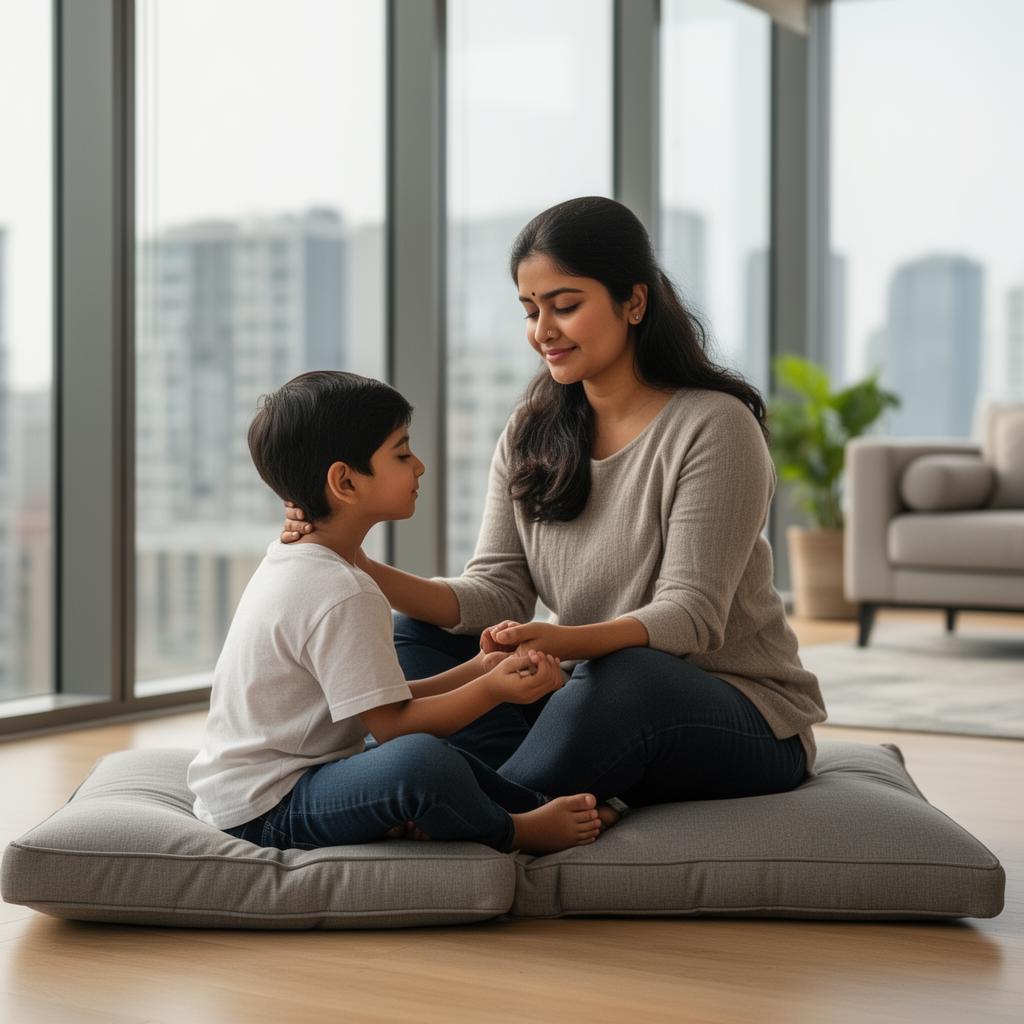
Conscious parenting explained for Indian families — what it means, what it doesn't mean, and how to apply it in a joint family context.
Every few years, a new parenting philosophy captures the Indian middle-class imagination and spreads like wildfire through WhatsApp groups, Instagram reels, and parenting podcasts.
Helicopter parenting. Tiger parenting. Gentle parenting. And now — conscious parenting.
The term is everywhere. And yet, in my sessions with parents across India, I find that most of what people understand by "conscious parenting" is either a vague Western concept that doesn't map onto Indian family structures, a misinterpretation that has reduced it to permissiveness, or a performance they feel they are failing at daily.
So let me explain it clearly — in the language of Indian families, Indian homes, and Indian cultural realities.
What Conscious Parenting Is NOT
I need to start here because the misconception is so common it is actually causing harm.
Conscious parenting is not:
Letting your child do whatever they want • Eliminating rules, boundaries, or consequences • Apologizing to your child every time you are firm • Never getting angry or saying no • Putting your child's preferences above all other considerations
I encounter parents who have absorbed this version of conscious parenting — usually from social media — and are exhausted, resentful, and confused. They have no boundaries. They negotiate everything. They feel guilty every time they assert authority. And their children are, frankly, struggling with the absence of clear, loving limits.
That is not consciousness. That is confusion.
Here is the actual definition: Conscious parenting means responding to your child from awareness and intention rather than reacting from your unexamined past.
Read that again slowly.
The emphasis is on you. Not on a particular parenting technique, not on a specific response to a specific behavior. On the parent's own internal state. On whether you are present, aware, and choosing your response — or whether you are being run by patterns, triggers, and unprocessed emotional material from your own history.
The Intergenerational Pattern at the Heart of Everything
Here is the insight that I consider the most important thing I teach in my coaching programs. It is simple to state and takes a lifetime to truly integrate:
We parent the way we were parented — unless we make a conscious choice to do otherwise.
Not always. Not in every situation. But in the moments of stress, trigger, and reactivity — when the prefrontal cortex goes offline and the limbic system takes over — we almost always fall back on the templates we received.
The father who tells his son "stop crying, boys don't cry" was almost certainly told the same thing. He didn't decide this was good policy after careful consideration. It is simply what was modeled to him as the appropriate response to male tears. It sits in his nervous system as automatic — the default response to an emotional boy child.
The mother who constantly compares her daughter to other girls may herself have grown up being compared to cousins and classmates. She doesn't consciously believe comparison is healthy. But the neural pathway — "comparison = motivation" — was laid in her own childhood. It fires automatically when she is anxious about her daughter's performance.
I share something personal when I speak to parents in my sessions. I grew up in circumstances that were not easy. My own relationship with my parents, my own experience of pressure and expectation, left marks that I had to consciously address before I could parent the way I truly wanted to. That process of self-examination — of asking "where does this reaction come from?" rather than simply having the reaction — is what I call conscious parenting.
In my Happy Parenting Club sessions, I often tell parents: "Aap wahi parenting de rahe ho jo aapko mili thi — unless aap jaanboojhkar kuch alag choose karo." You are giving the parenting you received — unless you consciously choose something different.

The Three Pillars of Conscious Parenting
Pillar 1: Self-Awareness — Knowing Your Triggers
Every parent has triggers. Specific behaviors, tones, situations that reliably produce a disproportionate reaction — a reaction that is actually not fully about the child in front of you but about something in your own history.
The child who talks back triggers a father who was never allowed to speak up as a child himself — and now the intensity of his reaction is about that old wound, not just the current behavior.
The child who is careless about studies triggers a mother who grew up in a family where academic performance was the primary measure of worth — and now her anxiety about her child's marks is threaded with her own unresolved relationship with that measuring system.
Conscious parenting starts with identifying your triggers. Not to eliminate them — you cannot eliminate triggers through willpower alone. But to create a gap between stimulus and response. A moment of awareness: "I am being triggered right now. What is actually happening in me, not just in my child?"
That gap — even half a second — is where conscious choice lives.
Pillar 2: Presence — Being Fully Here
The second pillar is deceptively simple and profoundly difficult for modern Indian parents, who are navigating extraordinary demands on their attention, time, and energy.
Presence means being psychologically available — not just physically located — when you are with your child.
A parent who is in the same room as their child but mentally composing a work email is not present. A parent whose eyes are on the child but whose mind is rehearsing an anxiety script about the future is not present. A parent who is listening to their child's words but internally already formulating the response, the lesson, the correction — is not present.
Children know. They always know. Not always intellectually — but in their nervous system, they sense when the parent is truly here and when they are somewhere else.
The quality of parental presence — the felt sense of being truly seen and received by your parent — is one of the strongest predictors of a child's emotional security and sense of worth that developmental psychology has identified. Not the amount of time. The quality of presence within the time.
Pillar 3: Intentionality — Choosing Who You Want to Be
The third pillar brings together self-awareness and presence into action: consciously choosing how you show up.
Not perfectly. Not without anger, not without conflict, not without mess. But with the question running underneath: "Is what I am doing right now aligned with the parent I want to be? Is this building the child I envision — or is this coming from my trigger, my fear, my unexamined history?"
This question — asked not once but continuously, as a practice — is what differentiates conscious parenting from simply applying techniques.
Conscious Parenting in the Indian Joint Family Context
The Western conscious parenting literature was largely written for nuclear families — two parents, two to three children, a single household authority structure. It offers limited guidance for the extraordinary complexity of the Indian joint family.
In a joint family, you are not just parenting your child. You are parenting within a generational ecosystem where:
Multiple adults hold authority • Parenting decisions are subject to family opinion and sometimes family override • Your child receives conflicting messages from different relationships • Your own relationship with your parents shapes your ability to parent your own children
Conscious parenting in a joint family requires additional layers:
Clarity about your primary authority. You and your partner are the primary parents. You receive and integrate wisdom from the family ecosystem, but final decisions about your children's raising are yours. This needs to be communicated — with respect and love, not as rebellion — to the broader family.
Protection without isolation. You cannot prevent grandparents from occasionally saying something that reflects their generation's parenting values. But you can create a private, consistent space with your child where you debrief, where you offer counter-narratives, where you remain the steady voice they can count on.
"Jo dadi ne kaha, woh unka pyaar hai. Hum ye bhi samajhte hain ki tum iske baare mein alag feel karte ho." What your grandmother said comes from love. And we also understand that you feel differently about it. This kind of sentence — offered privately, calmly — teaches the child to hold complexity without shutting down.
Working on your own relationship with your parents of origin. This is the deepest layer. Your triggers as a parent are often most activated in joint family environments because your own parents are present. The old wounds are closer to the surface. The old patterns are more easily activated.
Conscious parenting in a joint family often requires the parent to do deeper self-work — sometimes with professional support — around their own childhood experiences within that family system.
What Changes When You Practice Conscious Parenting
I want to be honest: conscious parenting is not a technique that produces results in 10 days. It is a practice. It is a direction of movement, not a destination.
But parents in my Happy Parenting Club who commit to this practice — consistently, over 90 days — report something remarkable:
Not that their children became perfectly behaved. But that the home became calmer. That power struggles decreased not because the child changed but because the parent stopped escalating them. That the child began opening up more — because the environment had become genuinely safer. That the parent experienced less guilt, more confidence, and a deeper sense of alignment between their values and their actions.
The change starts in the parent. The child responds to the change in the parent. This is the direction of flow in conscious parenting — and it is the opposite of most conventional parenting advice, which focuses on changing the child.
"Connection before correction. Awareness before advice. Love before lesson."
— Parikshit Jobanputra, 22+ years of parenting coaching
Frequently Asked Questions
Responding to your child from awareness rather than reacting from your unhealed past — interrupting generational patterns while honoring Indian cultural wisdom.
No. Conscious parenting is not permissive. It means being firm AND loving simultaneously — not choosing one over the other.
Happy Parenting Club
— Parikshit Jobanputra
Join the Conversation
Share your thoughtsLoved a takeaway? Have a question? Drop a comment below — Parikshit personally reads every thoughtful response.
Ready to Transform Your Parenting?
Prepare your child for the Future of AI with India's leading parenting coach.