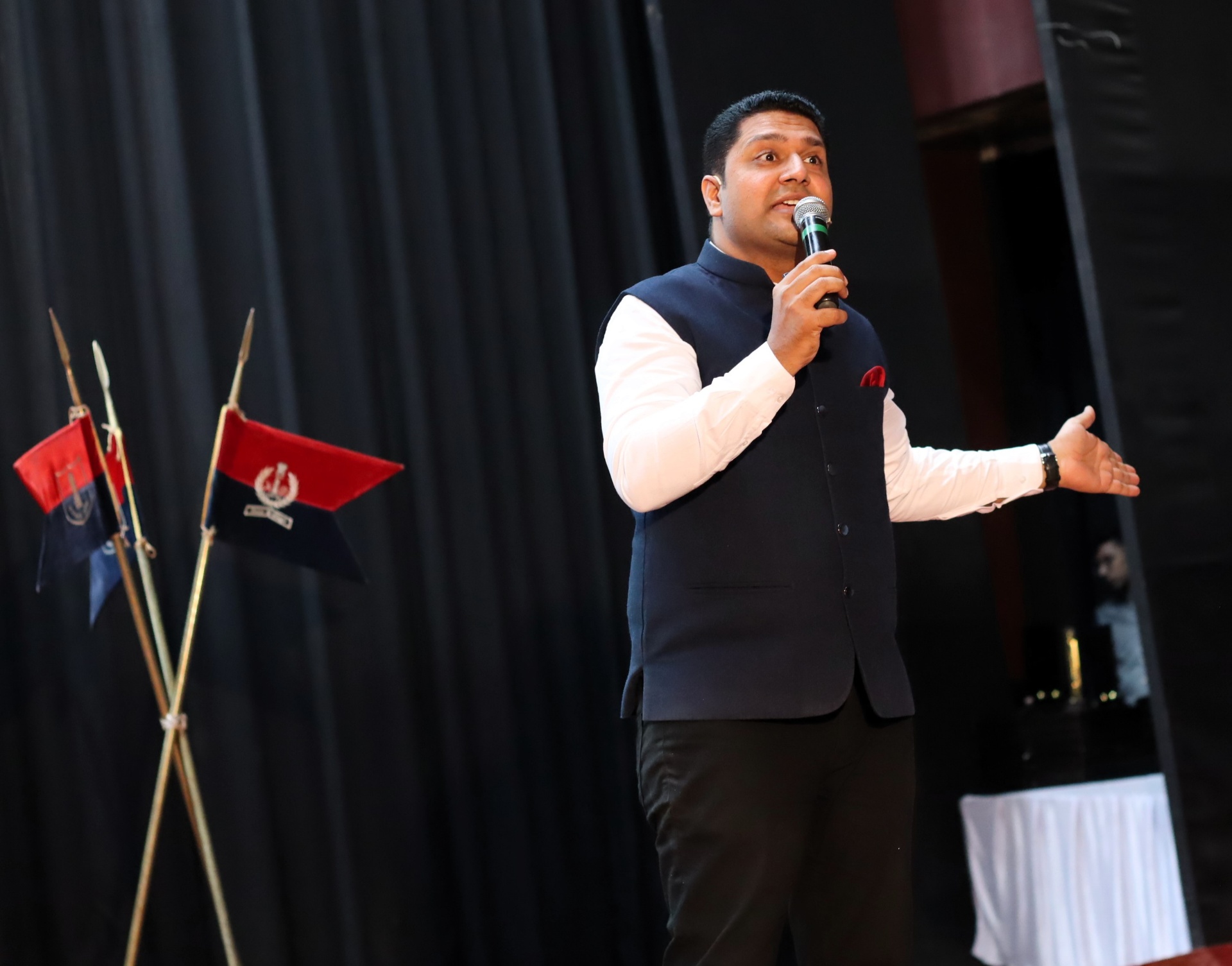
A deeply personal letter to every Indian parent who is trying their best and wondering if it's enough. Raw, honest, and from the heart of 22 years of work.
Dear Parent,
I want to write to you the way I would if we were sitting across from each other in my office — not as an expert behind a microphone or a stage, but as someone who has spent 22 years sitting with families like yours, witnessing what you carry, and feeling deep respect for what you do every single day.
Let me begin with something I genuinely mean, and that I want you to receive without deflecting it:
You are doing something extraordinary. You are raising a human being in the most complex, rapidly changing, information-saturated, pressure-filled era in Indian history. And you are doing it, mostly, without a manual.
The generation before us parented in a world that changed slowly enough for their parents' wisdom to still be relevant. The cultural templates, the family structures, the relationship between education and career, the role of technology in childhood, the social environment your children navigate — these have changed so fundamentally in one generation that the map we received from our parents barely fits the territory.
You are navigating new ground. Without GPS. Often without sleep.
I see you.
What 22 Years Has Taught Me About Indian Parents
Across 22 years and 50,000+ families — parents from every state, every economic background, every family structure in India — I have observed something consistent:
Indian parents love their children with a fierceness that is genuinely among the most beautiful things I have ever witnessed.
The father who stays awake until 2 AM helping with a project he doesn't fully understand — because his child asked for help and he will not let that ask go unanswered. The mother who quietly reduces her own food portion at dinner so there is enough for the children. The grandparents who give their life savings for a grandchild's education without being asked. The parent who takes the late-night train to be present for a school event they almost missed.
This is love that doesn't require language to be understood. It speaks in actions, in sacrifices, in the specific gravity of a parent's attention fixed entirely on their child's wellbeing.
That love is the foundation. It has always been there. And it will always be there.
But love — even this fierce, this devoted, this real — is not always enough on its own.
The Gap That Knowledge Fills
Here is what I have observed, with consistency and with compassion, across thousands of families:
You can love your child deeply and still, without awareness, do things that hurt them.
Not because you are cruel. Not because you don't care. But because you are working from a template — from the parenting you received, from cultural patterns that were handed to you as normal, from a nervous system that was shaped by experiences you never chose — and sometimes that template does not serve the child you are trying to love.
The father who shouts to establish authority was almost certainly shouted at himself. He is not choosing this because he believes it is best. He is defaulting to it because it is what he has on record.
The mother who compares her child to cousins to motivate them was almost certainly compared herself. She is not doing it from cruelty. She is doing it because she received it as the method for pushing children toward excellence.
These patterns are not character flaws. They are inherited programs running in the background.
And the beautiful, profound truth that I have watched transform thousands of families is this: these programs can be changed. Not with willpower alone. With knowledge, with awareness, with the right support — they can be interrupted, examined, and replaced with choices that more fully express the love that was always there.
This is what I mean when I say: love is the foundation, and knowledge completes the structure.
My Own Story
I want to share something personal with you, because I believe in the power of honest testimony.
I did not grow up with a model of ease. I was a young man who failed in three subjects. Whose salary was ₹700 a month. Whose hands were black with mechanic's grease, and who had friends who wouldn't shake them.
I know what it is to feel like the gap between where you are and where you want to be is too wide to cross. I know what it is to doubt whether you have what it takes — not just as a professional, but as a father, as a husband, as a human being trying to build something meaningful.
What changed my life was not talent I didn't have. It was a decision — the kind of decision that looks ordinary from the outside but feels like everything from the inside — to learn. To become the parent I wanted to be instead of the parent I had automatically become. To ask: what does my child actually need from me? Not what am I used to giving — what does this specific child, in front of me, with this specific nervous system, at this specific developmental stage, actually need?
Asking that question changed everything. Not because the answers were always easy. But because asking it turned me from a parent running on autopilot into a parent making conscious choices.
And conscious choices, made consistently over time, change families.
The Most Important Thing I Want You to Know
Here is the message I want you to carry away from everything I have written in this article — and in all the work I do:
You do not need to be a perfect parent. You need to be a growing one.
Perfect parents don't exist. And children raised by parents who were desperately trying to perform perfection often carry the weight of that performance in their own psychology for decades.
What children need is not perfection. They need:
A parent who tries. Who fails sometimes, as all humans do. Who takes responsibility for the failures without excessive self-flagellation. Who says, clearly and without defensiveness, "I handled that badly. I'm sorry. Let's try again." Who gets up the next morning and makes a different choice.
They need a parent whose love is so deep and so consistent that the child can feel it — not just in the celebrations, not just in the good days, but in the ordinary Tuesday evenings, in the way you stop what you're doing when they walk into the room, in the way you listen when they speak even about things that seem small to you.
They need a parent who is growing.
What I Have Seen Growth Produce
I want to close with specific testimonies — because abstract encouragement is less powerful than concrete proof.
The parent who emailed me at 11 PM: "I finally had a real conversation with my 14-year-old for the first time in two years. I don't know what changed but he told me something about his life tonight that I didn't know. I cried after he went to sleep."
The father in one of my workshops who arrived certain that his child's behavior was the problem, and who called me three months later to say: "I realized I was the one who needed to change. I stopped shouting. My son is different. My home is different. I am different."
The mother who had not spoken to her own teenager in any real way for eight months — walls so thick she had given up — who, after learning a single framework about teenage neurology, said: "I tried it on a Thursday evening. She talked to me for 45 minutes. She talked to me."
These are not dramatic transformations achieved through extraordinary means. They are ordinary parents who received a piece of knowledge they didn't have, applied it with consistency and love, and watched their family respond.
This is available to you. Not in a year. Not after everything in your life is in order. Now. From wherever you are, with whatever you currently have.
A Personal Invitation
If you have read this far, something in you is ready for this work. And I want to meet you there.
In my Happy Parenting Club, I work with parents who are exactly where you are — trying hard, loving deeply, wanting more knowledge and more support than they currently have. Who want to parent not just from love but from understanding. Who want to give their child not just care but the specific, science-backed, culturally grounded guidance that produces genuinely happy, resilient, capable human beings.
Twenty-two years. 50,000+ families. One mission: Happy Parenting for every Indian home.
That mission starts with one parent deciding that the family they want is worth the work of building it.
With deep respect for everything you are already doing,
Parikshit Jobanputra • India's Leading Parenting Coach • Founder, Happy Parenting Club • 22+ Years · 50,000+ Families
"Connection before correction. Awareness before advice. Love before lesson."
— Parikshit Jobanputra, 22+ years of parenting coaching
Frequently Asked Questions
Parikshit Jobanputra is India's leading parenting coach with 22+ years of experience, founder of the Happy Parenting Club, and creator of India's first parenting coach certification program with a mission to train 10,000 coaches across India and abroad.
Happy Parenting Club is India's premier parenting community founded by Parikshit Jobanputra, offering coaching, certification programs, and ongoing parent education.
Happy Parenting Club
— Parikshit Jobanputra
Join the Conversation
Share your thoughtsLoved a takeaway? Have a question? Drop a comment below — Parikshit personally reads every thoughtful response.
Ready to Transform Your Parenting?
Prepare your child for the Future of AI with India's leading parenting coach.