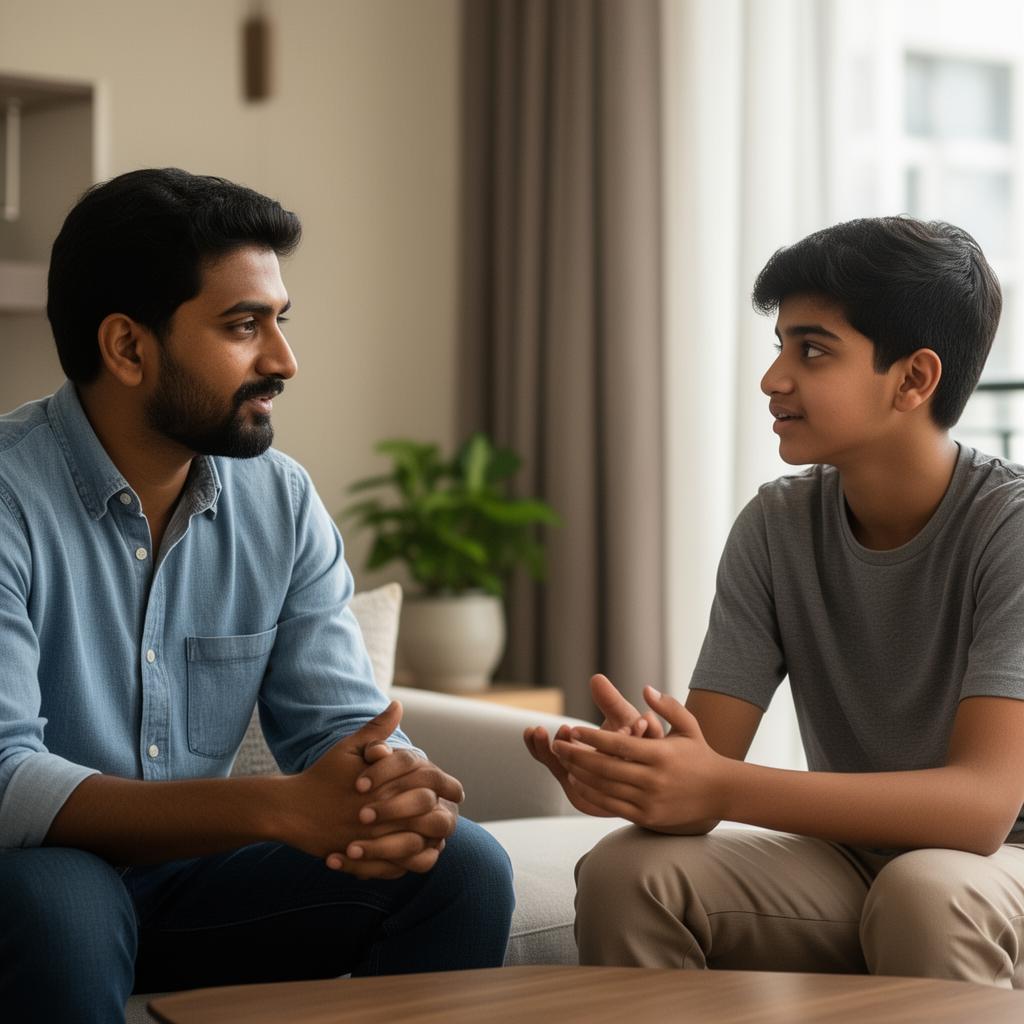
Why do Indian teenagers stop talking to their parents? A practical conversation framework backed by teen brain science to rebuild connection.
One day, your child told you everything.
Their school dramas. Their small victories. Their worries about the test on Thursday. Their falling-out with a best friend. They wanted to sit next to you. They followed you around the house to tell you things. Your opinion mattered to them in a way that was visible, tangible, and deeply moving.
Then, somewhere between age 12 and 15, something shifted.
One-word answers. Closed door. "Fine." A wall that feels not just physical but cellular — as if some part of them that used to be open to you has quietly, permanently closed.
If this is your home right now, I want to say the most important thing first: This is not rejection. This is neurology. And it is completely reversible — if you approach it correctly.
What is Actually Happening in the Teenage Brain
The teenage brain is undergoing the second most dramatic neurological renovation of an entire human lifetime. The first is ages 0–3, when billions of new neural connections are formed at an extraordinary rate. The second is adolescence — roughly 11 to 24 — when the brain undergoes a profound pruning and reorganization process.
What is being renovated? The prefrontal cortex — the seat of logic, long-term thinking, empathy, emotional regulation, and perspective-taking.
What is fully operational during this renovation? The limbic system — the emotional, reactive, pleasure-seeking, risk-reward processing center of the brain.
Neuroscientist Dr. Sarah-Jayne Blakemore at University College London describes the teenage brain as one that is particularly sensitive to social rewards and social threats, highly responsive to peer evaluation, and operating with an imbalanced ratio of emotional reactivity to rational regulation.
This means your teenager is navigating a neurological storm while simultaneously being expected to perform academically at the highest level of their schooling, manage complex social dynamics, figure out who they are, and comply with the authority structures of an Indian family system that often doesn't leave much room for the identity exploration they are neurologically driven to pursue.
No wonder they shut down.
The 4 Real Reasons Indian Teenagers Stop Talking to Their Parents
In my 22+ years of parenting coaching across India, I have identified four specific patterns that cause teenagers to go silent. Understanding these is the first step to changing them.
Reason 1: Every Sharing Becomes a Teaching Moment
Your teenager mentions, casually, that they had a fight with a friend at school. In the next sixty seconds, you have connected it to their need to be more careful about friendship choices, reminded them that this is why you always said not to trust too easily, and concluded with a comment about how this is what happens when they spend time with the wrong crowd.
The teenager did not ask for any of this. They shared something. And before they finished the sentence, they received a 3-minute life lesson.
After enough of these experiences, the brain makes a very rational calculation: sharing leads to lectures. Silence leads to peace. And silence wins.
I tell parents in my coaching sessions: every time you respond to your teenager's sharing with advice, correction, or a connected lesson — without being asked — you are making a withdrawal from the relationship account. The account can only absorb so many withdrawals before the teenager stops making deposits.
Reason 2: Their Emotions Are Dismissed as Disproportionate
"You have nothing to worry about. It's just a test." "Stop being so dramatic. It's not the end of the world." "Why are you crying over something so small?"
The teenager's emotional experience is real. To their nervous system — which is running on a limbic system in overdrive — the intensity of what they feel about a friendship conflict, a perceived social rejection, a bad grade, or an unfair comment from a teacher is not disproportionate. It is exactly how their brain processes it.
When we dismiss that experience as "too much," we communicate something devastating: "Your inner world is not welcome here." And teenagers — who are already uncertain about almost everything — learn quickly where they are and are not safe to bring their full experience.
Reason 3: The Relationship Feels Like Surveillance, Not Connection
"Where were you?" "Who were you with?" "Why didn't you text?" "What are your grades this week?" "Have you finished your homework?" "What do you plan to do about your marks?"
These are not relationship conversations. These are monitoring conversations. And while they come from genuine care and concern, they communicate to the teenager: "I am primarily your manager, not your companion."
Teenagers — developmentally — are in the process of individuating. They are building a separate identity from their parents. This is healthy. This is necessary. But it creates a powerful need to have the parent remain a safe, interested companion through the process — not a surveillance system they need to evade.
Reason 4: The Family System Doesn't Feel Safe for Honesty
If the last time your teenager shared something real — a mistake, a struggle, an uncomfortable truth — it resulted in anger, extended lectures, withdrawal of privileges, or comparison to a sibling or cousin, they have learned something important:
Honesty is dangerous here.
And so they give you what is safe. One-word answers. "Fine." "Nothing." The social performance of a child who is doing okay, because that performance costs less than the truth.
The 3-Part Conversation Framework That Actually Works
I developed this framework over many years of coaching Indian families with teenagers. It is deceptively simple. It requires enormous practice. And when done consistently, it rebuilds connection across even the most damaged parent-teenager relationships.
Part 1: Create a Listening Environment, Not a Teaching Environment
The single most important skill in parenting a teenager is the ability to listen without immediately redirecting, advising, correcting, or connecting what they shared to a lesson.
When your teenager speaks to you, your only job for the first 3–5 minutes is to reflect and ask. Not advise. Not correct. Not teach. Just:
"That sounds really hard." "Tell me more about what happened." "How are you feeling about it?"
I know this feels passive to parents who are used to being fixers, educators, and guides. It is not passive. It is the most active thing you can do — it requires you to override your instinct to help by fixing, and instead help by witnessing.
The moment a teenager feels truly listened to — without the sentence turning into a lesson — something shifts in their nervous system. The amygdala relaxes. The walls come down slightly. They share a little more. And you have the beginning of a real conversation.
Part 2: Ask Questions From Curiosity, Not Surveillance
There is a profound difference between:
"How was school?" — This is a checkbox question. It invites a one-word answer and signals obligation, not genuine interest.
"What was the most interesting thing that happened today?" — This is a curiosity question. It invites reflection, signals genuine interest, and communicates: I find you interesting as a person.
"Did you finish your homework?" — Surveillance. "What subject are you most excited about this term?" — Curiosity.
Teenagers talk to people who are genuinely interested in them. Become genuinely interested in your teenager as a person — their opinions, their observations, their humor, their dreams — not just their performance metrics.
Part 3: Offer Your Own Vulnerability
This is the step that consistently surprises parents most. And it is consistently the most powerful.
Teenagers open up when they see their parents as human beings navigating life — not as authority figures performing parenthood.
When you share something real from your own experience — a time you failed, a time you felt exactly what they are feeling, a struggle you are having right now — two things happen: you normalize the human experience of difficulty and confusion, and you give them permission to be imperfect in your presence.
"I remember feeling exactly like that at your age. I was so convinced that everything was ruined, and it turned out fine — but I couldn't see that then."
That one sentence, said genuinely and without using it to pivot to a lesson, can undo months of distance.
The Joint Family Dimension
For families in joint households — which is still the majority of Indian families — this is more complex. Teenagers in joint families often feel watched and evaluated by multiple authority figures simultaneously. The privacy and experimentation they are developmentally driven to seek is structurally limited.
My specific guidance: Create one protected ritual between just you and your teenager. Weekly. A drive, a chai, a walk, a regular Sunday morning where you are reliably available without agenda, without phone, without other family members present.
This weekly, consistent, distraction-free time sends a message that accumulates: "You have a person in this house who is specifically here for you." That message — delivered not in words but in the repeated behavior of showing up — is the foundation of a relationship your teenager will return to, even when they are pushing every other boundary.
"Connection before correction. Awareness before advice. Love before lesson."
— Parikshit Jobanputra, 22+ years of parenting coaching
Frequently Asked Questions
Most conversations become lectures, feelings aren't taken seriously, comparisons dominate, and teens learn sharing isn't safe. Connection requires listening first.
Create a listening environment not a teaching environment, ask questions from curiosity not surveillance, and share your own vulnerabilities honestly.
Happy Parenting Club
— Parikshit Jobanputra
Join the Conversation
Share your thoughtsLoved a takeaway? Have a question? Drop a comment below — Parikshit personally reads every thoughtful response.
Ready to Transform Your Parenting?
Prepare your child for the Future of AI with India's leading parenting coach.