The neuroscience of mobile addiction in Indian children — and the practical, guilt-free 21-day plan to reset your child's relationship with screens.
Let me say the quiet part out loud.
You didn't give your child a phone to ruin them. You gave it to them for 10 minutes of peace while you finished a work call, cooked dinner, or just needed to breathe for a moment without someone needing something from you.
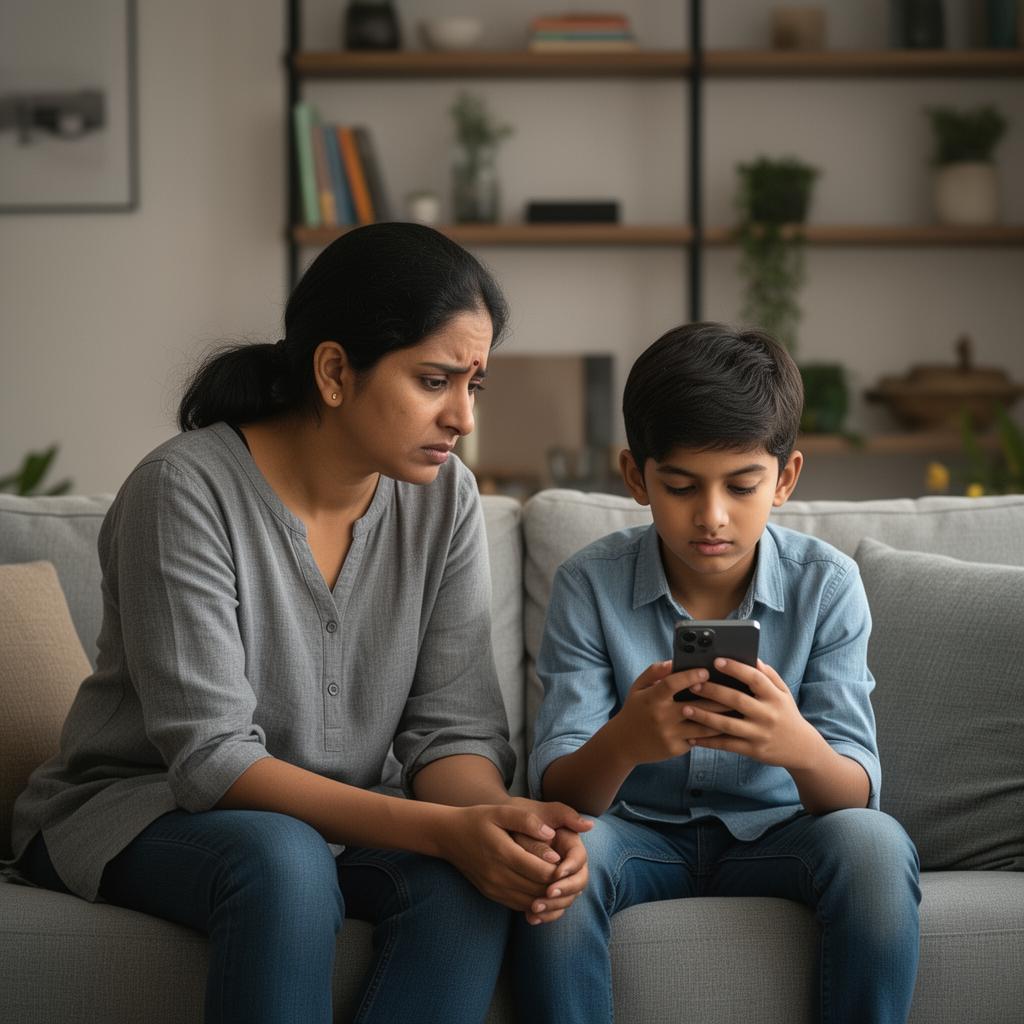
And now, months later, you are in a daily battle — tears at the dinner table, rage when you ask them to put it down, a child who seems to care more about a glowing screen than about you, their homework, their friends, or anything that used to matter to them.
In 22+ years as India's leading parenting coach, I have sat across from hundreds of parents who arrived at my coaching sessions carrying exactly this guilt. Parents from Delhi, Pune, Surat, Hyderabad, and small towns in Gujarat. The city changes. The guilt doesn't.
Here is the very first thing I tell every single one of them: You are not a bad parent. But there is a real problem — and it has a name, a mechanism, and a solution.
Let's go through all three.
The Name: Behavioral Addiction
What your child is experiencing is not laziness, bad character, or defiance. What they are experiencing is a behavioral addiction — a compulsive pattern driven by neurochemical reward cycles in the brain.
The word "addiction" is strong. I use it intentionally. Because softening it — calling it "too much screen time" or "a bad habit" — means we address it at the wrong level of intensity. When a parent walks into my coaching session thinking their child has "a bad habit," they try mild strategies. When they understand their child's brain has been caught in a dopamine loop engineered by the world's most sophisticated behavioral design teams, they treat it with the seriousness it deserves.
And then real change happens.
The Mechanism: The Dopamine Trap
Every YouTube video. Every Instagram reel. Every Minecraft update notification. Every new level of BGMI.
These were not designed by accident. They were designed — by teams of behavioral psychologists, neuroscientists, and UX engineers, backed by billions of dollars — to trigger one specific neurochemical in your child's brain: dopamine.
Dopamine is the brain's "wanting" chemical. Not the "enjoyment" chemical — the "wanting more" chemical. It is the chemical that drives anticipation, craving, and pursuit. Every notification, every like, every autoplay fires a small dopamine hit. And the brain, in response, learns: "This is where reward comes from. Go back. Go back. Go back."
The problem is that children's brains are extraordinarily vulnerable to this mechanism — for a very specific developmental reason.
The prefrontal cortex — the part of the brain responsible for impulse control, delayed gratification, and the ability to say "I've had enough" — doesn't fully develop until age 25. This means the very capacity that would allow a child to regulate their own screen use is precisely the capacity that is still under construction.
The technology companies know this. Their data teams track it. And their products are optimized accordingly.
Real life cannot compete with this engineering.
After two hours of dopamine hits from a screen, homework feels boring. A family conversation feels dull. Even food becomes less interesting. Your child's brain has been temporarily recalibrated to expect high-stimulation rewards constantly — and now everything that doesn't deliver that level of stimulation registers as flat, uninteresting, and not worth engaging with.
This is not a character flaw. This is neuroscience. And it is reversible.
The 3 Warning Signs That Indian Parents Miss
Most parents who come to me have already crossed one or more of these lines — without recognizing what they were seeing:
Warning Sign 1: Rage at Disconnection
When you take the phone away — or even ask your child to put it down — and they respond with tears, screaming, or physical aggression disproportionate to the situation, you are witnessing a withdrawal response.
This is neurologically identical to how the brain responds to withdrawal from any substance that has been creating dopamine dependency. The brain has learned to expect the chemical reward. When it is removed, the stress-response system activates. The child is not being dramatic. They are in genuine neurological distress.
Understanding this doesn't mean accepting the behavior. It means responding to it correctly — which is very different from confiscating the phone in anger and hoping the problem disappears.

Warning Sign 2: Inability to Self-Entertain
Here is a simple test I give parents in my coaching sessions: ask your child to sit quietly with no device, no TV, no external stimulation for 20 minutes.
Not "won't." Can't.
If your child genuinely cannot tolerate unstructured time without a screen — if they become agitated, anxious, bored to the point of distress within minutes — the dopamine threshold in their brain has been raised. Real life, with its natural, moderate stimulation levels, no longer registers as satisfying.
This is one of the clearest early indicators that the dependency has moved beyond "preference" into something that needs active, deliberate reset.
Warning Sign 3: Loss of Previously Loved Activities
I ask parents in my sessions: "What did your child love doing before the phone became central to their life?"
Cricket in the colony. Drawing. Playing with the neighbor's children. Reading. Cooking with you in the kitchen.
When those activities — the ones that once lit up your child's face — have quietly disappeared and been replaced entirely by screen time, you are seeing the dopamine baseline being permanently reset upward. The brain no longer finds natural, moderate-stimulation activities rewarding enough to pursue.
This is the sign that most breaks parents' hearts. And it is the one that tells me the most about where a family is in the journey.
The Most Common Mistake Indian Parents Make: Cold Turkey
One day, you've had enough. You take all the devices. You lock them away. You tell your child: "No more screen time until further notice."
What happens?
Massive resistance. Escalating conflict. Possible damage to the relationship. A miserable week for everyone in the house. And two to three weeks later — back to square one, sometimes with the child having found workarounds, hidden devices, or neighborhood friends who provide the access they couldn't get at home.
This is not a failure of willpower — yours or your child's. It is a failure to understand how addiction works neurologically.
Sudden removal of a dopamine source spikes cortisol — the stress hormone — and puts the brain into emergency survival mode. The child's entire cognitive and emotional energy goes into getting the dopamine source back. Nothing productive can happen in that state. No learning, no connection, no repair.
The solution is not removal. The solution is reset.
My 21-Day Screen Reset Plan for Indian Families
I have guided hundreds of families through this process in my Happy Parenting Club coaching sessions. It works — when it is followed with patience and consistency. It does not work when parents want a 3-day shortcut.
Week 1 — Awareness Without War (Days 1–7)
Do not remove the device. Not yet.
Instead, introduce what I call a Screen Diary. Each day, your child writes or tells you three things: What did I watch or play today? For how long? How did I feel after?
No judgment. No lectures. No consequences attached to the answer. Just awareness.
This step is deceptively powerful. It does something the screen is specifically designed to prevent: it activates the prefrontal cortex — the thinking brain — around screen use. It creates a moment of reflection in a loop that is entirely designed to prevent reflection.
Most children, within 5–7 days of this exercise, begin to self-report things like: "I felt kind of bored after." Or: "I watched for 3 hours and I don't even know what I watched." That self-awareness is the first crack in the wall.
Week 2 — Replace, Don't Remove (Days 8–14)
Now you begin reducing screen time — but the reduction must be accompanied by replacement, not emptiness.
For every 30 minutes of screen time you want to reduce, introduce a replacement activity that offers genuine dopamine stimulation: outdoor play, a creative challenge, cooking together, a physical game, music practice, a 15-minute competitive activity with a family member.
The brain needs dopamine. Your goal is not to eliminate dopamine — it is to diversify the sources. Screens as the only dopamine source create dependency. Multiple sources create balance.
I tell parents in my sessions: "Time + activity = freedom. Humen kaam karna padega — but smart work, not hard work." The same applies here. Don't fight the brain's need for reward. Redirect it.
Week 3 — The Family Screen Contract (Days 15–21)
This is the step that creates lasting change.
Sit down as a family and co-create your screen agreements. Not rules handed down from parent to child — agreements built together.
Research from Harvard's Center on the Developing Child shows that children who participate in creating behavioral guidelines follow them 3 times more consistently than children who have rules imposed on them. This is not permissiveness. This is strategic use of your child's need for agency.
Your Screen Contract should include:
Screen-free zones: Dining table. One hour after school. One hour before bed. Screen-free times: Family dinner. Outdoor time on weekends. How screen time is earned: After homework, after physical activity. What happens if the contract is broken: Decided together, calmly, in advance — not in the heat of conflict.
Post it on the refrigerator. Signed by every family member. Including you.

The Conversation That Changes Everything
In my 22 years, there is one question I ask parents that changes everything. I want to ask you now:
What is your child escaping from when they go into the screen?
Because here is what I have learned from thousands of families: children who are deeply, genuinely connected to their parents do not need to escape into screens.
Screen addiction, in many homes, is not primarily a technology problem. It is a connection deficit. The screen offers something that is missing elsewhere: stimulation, engagement, the feeling of being in a world where they are capable, where they progress, where there are clear rules and immediate rewards.
More eye contact at dinner. More conversations that are not about grades or behavior. More moments where your child feels interesting to you — not just managed, not just monitored, but genuinely interesting. These are not soft sentiments. They are the most powerful protective factors against digital addiction that research has identified.
The phone is a symptom. Your presence is the medicine.
"Connection before correction. Awareness before advice. Love before lesson."
— Parikshit Jobanputra, 22+ years of parenting coaching
Frequently Asked Questions
A gradual 21-day reset works better than confiscation. Introduce a screen diary, replace screen time with stimulating alternatives, and co-create a family screen contract.
Most child development experts recommend no personal smartphones before age 13, with supervised time-limited use from 10–12.
This is a neurological withdrawal response triggered by dopamine dependency. A gradual reset approach is more effective than sudden removal.
Happy Parenting Club
— Parikshit Jobanputra
Join the Conversation
Share your thoughtsLoved a takeaway? Have a question? Drop a comment below — Parikshit personally reads every thoughtful response.
Ready to Transform Your Parenting?
Prepare your child for the Future of AI with India's leading parenting coach.