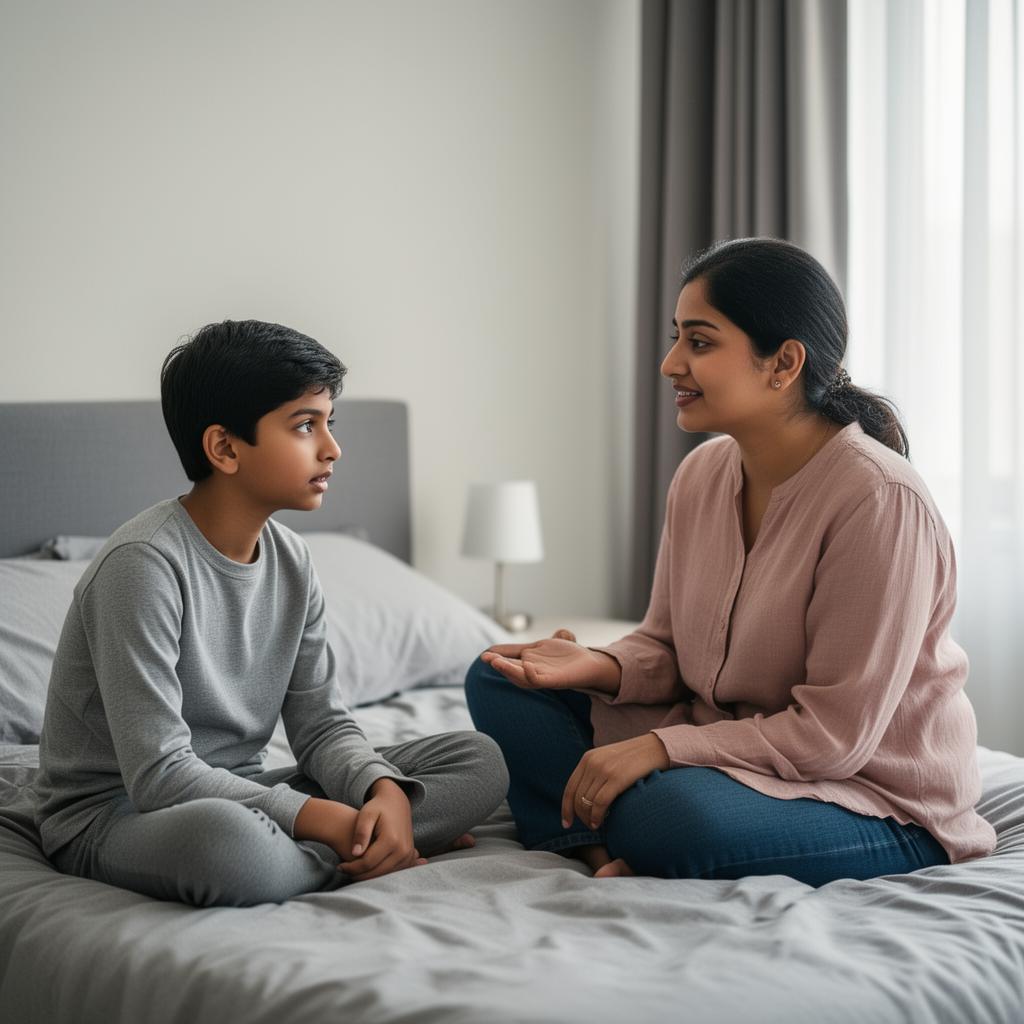
1 in 5 Indian children experiences a mental health challenge before 18. Early warning signs most parents miss — and how to respond with support, not shame.
India is in the middle of a quiet mental health emergency that most families are navigating without the language, the resources, or the permission to name what they are seeing.
According to the National Mental Health Survey of India, approximately 1 in 5 children and adolescents — that is 20% of the child population — experience a significant mental health challenge before the age of 18. Anxiety disorders are the most common, followed by depression, ADHD, and conduct disorders.
Of these, the vast majority go unrecognized and untreated.
Not because Indian parents don't care. They care deeply and fiercely. But because the cultural framework — in which mental health is either invisible, stigmatized, or attributed to weakness and laziness — prevents recognition, acknowledgment, and help-seeking until a crisis point is reached.
I want to change that with this article. Not by adding to anyone's anxiety as a parent. But by giving you the specific, practical knowledge that allows you to see clearly what is in front of you — and respond with support, not shame.
Why Indian Families Miss the Early Signs
Before I describe the warning signs, I want to describe why they are so consistently missed in Indian homes — because this "why" is necessary for the knowledge to be useful.
The normalization of suffering. In a culture where generations have managed profound hardship through stoicism and endurance, a child's emotional distress can be seen as normal difficulty — "character building" — rather than as a signal that something needs attention.
The academic performance screen. Indian parents are acutely attuned to academic performance. If a child is still managing their grades, the assumption is that they are "okay." But children can maintain functional academic performance while carrying significant internal distress for extended periods.
The absence of emotional vocabulary. If a family doesn't regularly talk about emotional experience — if feelings are not named, shared, or explored in the home — a child will not have the language to say "I am anxious" or "I feel depressed." They will say "I'm fine" — and mean it in the sense that they have no other words for what they are experiencing.
The stigma around mental health. The fear of what neighbors, relatives, and school will say if it becomes known that a child is seeing a psychologist or has been diagnosed with anxiety — this fear prevents help-seeking in families across every economic and educational background.
Understanding these barriers doesn't make them disappear. But naming them is the first step to moving through them.
The Early Warning Signs: What to Watch For
Changes in Sleep Architecture
Sleep is one of the most sensitive indicators of the state of the nervous system. Long before a child can articulate distress, their sleep will often begin to change.
Watch for: consistent difficulty falling asleep (lying awake for more than 30 minutes after lights out), waking repeatedly through the night, dramatically increased sleep (more than 10 hours and still groggy), nightmares or night terrors that begin suddenly, or resistance to going to bed that seems driven by anxiety rather than preference.
One of these patterns, once or twice, is normal life. A pattern that persists for more than 2–3 weeks warrants gentle attention.
Withdrawal from Previously Loved Activities
This is the sign I consider most reliable, and most consistently overlooked.
When a child who has loved cricket for three years suddenly loses interest — not because of a new interest replacing it, but simply losing interest — when a child who used to love drawing or music or cooking with you quietly stops doing it without explanation — when a previously social child begins declining invitations to be with friends — you are seeing one of the clearest neurological signatures of depression or anxiety.
The brain under sustained stress or depression reduces its investment in reward circuits — the very circuits that make activities feel pleasurable and worth pursuing. The child is not being lazy or dramatic. The neurotransmitter systems that produce engagement and pleasure are not functioning normally.
Unexplained Physical Symptoms
In children — and in adults who were raised to suppress emotional expression — emotional distress often surfaces through the body before it finds language.
Recurring headaches with no medical explanation. Stomachaches that reliably occur on school mornings. Fatigue that no amount of sleep resolves. Unexplained pain in joints or muscles.
When a child presents with physical symptoms that multiple medical investigations cannot explain, this is almost never the child being manipulative. This is the nervous system finding the only pathway available to express what the mind hasn't yet found words for.
Medical investigation is appropriate and necessary. But if the medicine comes back clear and the symptoms persist, the conversation needs to shift to the emotional and psychological.
Changes in Irritability and Anger
This is the one that most consistently misleads Indian parents — because it looks like a behavior problem rather than a mental health signal.
Children with anxiety and depression frequently present as irritable, short-tempered, easily provoked, and explosively angry — rather than sad and withdrawn in the way many parents expect depression to look.
The anger is real. But it is also a protective layer — the emotional armor over the vulnerability beneath. When a child is frightened, overwhelmed, or deeply sad in an environment where those feelings don't feel safe, the nervous system translates the softer emotions into anger — which feels more powerful and more controllable.
If your child has become significantly more irritable and prone to angry outbursts than before — particularly if this is a change from their previous baseline — treat it as a possible sign of underlying distress, not just as a discipline problem.
Persistent Negative Self-Talk
Children who are developing depression or anxiety often begin narrating a story about themselves that is persistently negative:
"I'm stupid." • "No one likes me." • "I can't do anything right." • "I wish I wasn't here." (This last one always requires immediate, serious attention.)
The occasional frustrated "I'm so stupid" after making a mistake is normal. A persistent pattern of negative self-description — particularly when it appears unprovoked or dramatically at odds with the child's actual capabilities — is a signal to take seriously.
How to Respond: The Indian Parent's Guide
Ready to Transform Your Parenting?
Join India's leading parenting coach Parikshit Jobanputra for a FREE live Masterclass.
Create the Environment Before the Crisis
The single most important thing you can do for your child's mental health is build an environment where emotional experience is welcome before any crisis occurs.
This means: regular, low-stakes emotional conversations. "What was hard today?" asked with genuine curiosity, as a normal part of dinner. "I noticed you seemed quiet today — is there anything going on?" asked without an agenda, with full acceptance of whatever answer comes.
Children who have this environment bring you their distress before it becomes a crisis. Children who don't, bring it to you much later — or never.
Take the Signs Seriously Without Creating Alarm
When you notice the warning signs, the goal is attentive engagement — not panic, not dismissal, and not the dramatic "something is very wrong with you" energy that shuts children down.
"I've noticed you haven't been sleeping well this week. How are you doing?"
"You don't seem to be enjoying cricket much lately. I wanted to check in."
These gentle, specific observations — said without alarm, with full openness to whatever comes next — invite the child into honest conversation. The tone matters as much as the words.
Seek Professional Support Early — Without Shame
Here is the message I want every Indian parent to receive and hold:
Consulting a child psychologist or mental health professional for your child is not an admission of failure. It is the same act of care as consulting a cardiologist when your child has heart symptoms.
Mental health is health. The brain is an organ. Disorders of the brain's emotional regulation systems are no different in kind from disorders of any other organ system — they have neurological bases, they respond to appropriate treatment, and they improve dramatically with early intervention.
The shame that prevents Indian families from seeking help is not protecting anyone. It is not protecting the family's reputation — because no one outside is helped by your child suffering. It is not protecting your child — because untreated childhood mental health challenges become adult mental health challenges.
Early intervention — in childhood and adolescence — produces dramatically better long-term outcomes than waiting until a crisis forces action.
Building Mental Health Literacy in Your Own Family
I want to extend this conversation beyond crisis recognition to something more foundational: building an ongoing culture of mental health awareness in your home, so that recognition and response become a natural part of family life rather than an emergency skill deployed only when something has already gone significantly wrong.
This means normalizing conversation about mental health the same way you normalize conversation about physical health. Talking about feelings the way you talk about meals — as a regular, unremarkable part of daily life. Modeling your own emotional experience honestly, in age-appropriate ways: "I had a hard day today, and I'm feeling a bit low. I'm going to take some time to rest." This teaches children that emotional struggle is a normal part of human experience — not a shameful secret to be hidden.
It also means actively counteracting the stigma narrative when you encounter it — in family conversations, in school environments, in social circles. When a relative dismisses mental health concerns as "just attention-seeking" or "Western nonsense," a calm, clear counter-statement — even just within your own household — protects your child from absorbing that stigma as truth.
The Protective Power of the Parent-Child Relationship Itself
I want to close with something research consistently confirms and that I have witnessed repeatedly in 22 years of this work: the single strongest protective factor against the development and escalation of childhood mental health challenges is not the absence of stress or difficulty in a child's life — life will always contain stress and difficulty — but the presence of at least one secure, available, emotionally attuned relationship with a parent or caregiver.
This means that everything else in this article — the rituals, the conversations, the willingness to seek help — sits on top of a foundation that you are likely already building, simply by being a parent who reads articles like this one, who cares enough to learn, who shows up for your child with intention.
That foundation, more than any specific technique, is what protects your child's mental health most powerfully. Trust that you are already doing meaningful work, even as you continue to learn and grow.
"Connection before correction. Awareness before advice. Love before lesson."
— Parikshit Jobanputra, 22+ years of parenting coaching
Frequently Asked Questions
Sleep changes, withdrawal from loved activities, unexplained physical complaints, increased anger/irritability, sudden drop in school performance, and excessive worry.
Yes. Mental health is health. Early professional support dramatically improves outcomes — just as you would consult a doctor for a physical illness.
Happy Parenting Club
— Parikshit Jobanputra
Join the Conversation
Share your thoughtsLoved a takeaway? Have a question? Drop a comment below — Parikshit personally reads every thoughtful response.
Ready to Transform Your Parenting?
Prepare your child for the Future of AI with India's leading parenting coach.